After years of wanting to learn the Tamizh script, and a couple of failed attempts, I finally read my first (of many, hopefully) ever Tamizh novel!
I wasn't planning to write a separate post on this but I ended up writing so much about it in my July wrap-up and realized that I actually have a lot to say. I took over a month to read this 63-page book and it felt like a journey. I consider myself a voracious reader but யானை டாக்டர் wasn't any regular book for me, mostly due to the language.
This post is going to be a mix of thoughts about the book/story and my experience reading Yaanai Doctor as a beginner Tamizh reader. If you are new to reading Tamizh and are looking for recommendations, this can help. If not, stay anyway and consider this a casual chat where I ramble to you over tea 🍵 (I actually have a full cup of tea next to me as I write this 😂)
what is யானை டாக்டர் about?
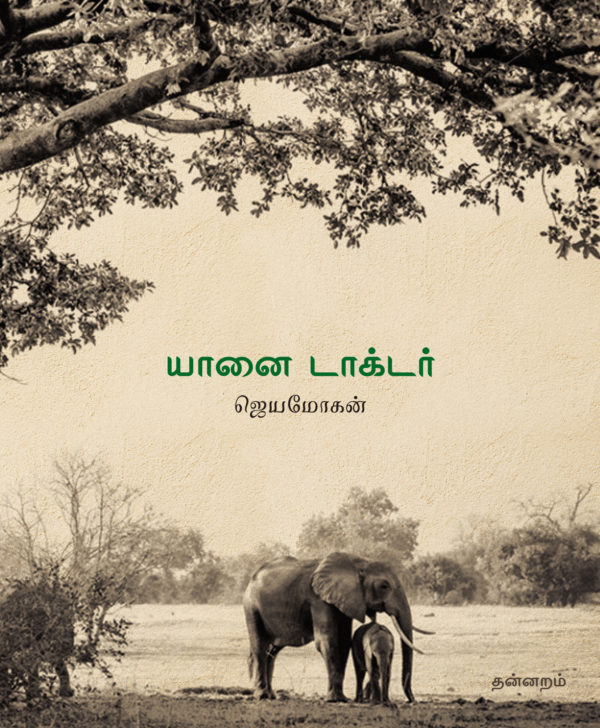
It's a short 63-page book written from the point-of-view of a forest officer who is a regular dude until he meets a veterinarian who opens his perspective about wildlife. It's inspired by a real-life renowned veterinarian Dr. V. Krishnamurthy. Once I found out the inspiration, the book felt like fan fiction, haha. Adoring fanfiction.
The book doesn't have a big "plot", it's mostly a collection of happenings and conversations which open the main character's (and the reader's) perspective. It's about the intelligence and social lives of elephants, how humans exploit/hurt elephants in different ways, wildlife conservation, and philosophies about nature. After learning by Dr. K's side, the officer is a changed man by the end.
It's a part of a collection of stories by the author called "Aram" but I read it as a standalone novel/novella.
my review & reading experience
Shoutout to r/tamilbooks and this YouTube video for recommending யானை டாக்டர். I spent a good while researching posts and videos to choose a good first book—something short and easy to read without a complicated plot. My mom told me to learn by reading magazines but I'm a book person and my motivation to "read my first Tamizh book" is greater than reader a handful of random articles. Considering my first two failed attempts at learning to read the language (got busy with other things, lack of long-term motivation), it was important to make the third time the charm.
For context, I am comfortable speaking Tamil/Tamizh. I speak it at home. I just never learnt to read or write it because I didn't grow up around the written language. I learnt to read other languages but not my mother tongue. This is also the first time I'm learning (part of) a language as an adult. (Not counting coding languages, of course 😆) Before this, all the language-learning I've done is as a young student. It was an interesting experience, and was actually quite fun. It was hard and frustrating, but fun.
I refreshed my memory of the alphabet by following a teacher on YouTube before attempting to read a book. I treated it like a proper class—setting aside time, making notes, and looking up some words to understand how the alphabets come together. I found a random Tamizh book in the library and read about 2 pages of it. Unfortunately, it was self-help and wasn't beginner-friendly. That's when I hunted for a book and settled on Yaanai Doctor. I couldn't find a physical copy but, very helpfully, it is on Kindle Unlimited!
For a bit more context in case you're not familiar with the language, the written and spoken versions aren't super similar. It's easy to see the similarities once you know how to read it but as a beginner, the words were alien to me until I figured out how to map them to the words I speak. My spoken dialect is also a bit different from the written text (we use a handful of different words and pronounce some key words differently), that was another learning curve. I kept going to my mom with "what does this word mean?" only to get the answer "it's this word for us, we don't use that/say it that way".
Another thing that tripped me up a lot initially is the way the letters work. Consonant + vowel combinations don't always follow the same rules as the other languages I know. It's not always left-to-right and letters are reused for some sounds and depending on where the letter is, the sound changes or vice versa. I got so frustrated, I vented to my mom for 15 minutes once and she said she never noticed those things. Perks of learning the language as a kid, I guess.
It was a steep learning curve in the beginning but it got easy pretty quickly once I figured out those things. It took me an hour to read a page in the beginning—I was learning by reading out loud to my mom and she'd correct me or explain stuff. I got tired pretty quickly too, my brain would get exhausted after about 30 minutes.
Very slowly I got the hang of reading full words at once and then I could start to understand the words. A good while later, I became comfortable enough to read the entire sentence at once without tripping up a lot. As soon as I could read full sentences properly, it was like something unlocked in my brain. It got much quicker after that. Reading sentences meant I could start understanding them without my mom's help. Once I was able to read multiple sentences, I started truly understanding the plot. I was able to grasp the meaning by matching the written words to my spoken dialect in my head. I was looking up almost every 3rd word in the beginning and could manage to read without looking up any by the end (even if I didn't understand every word, I got the context, like anyone does in English too).
I took over a month to read the first 30% and read the rest 70% in a WEEK. I am so proud of my reading in that week. It was incredible to see how quickly I could read and grasp things. It's the first time I've learnt and improved in something so quickly too. I did not expect it. Obviously, knowing how to speak the language was the main reason for it, but still. My spoken language is mostly of daily conversations at home only and I don't know the full vernacular. I expected that to be more of a problem but it wasn't here.
Yaanai Doctor was a good choice as a first Tamizh book because of multiple things. The length, of course. But also, the writing is mostly simple. Much of the descriptions are of mundane things like making tea, conversation, looking at animals, and descriptions of the forest. Once I learnt the forest vocabulary used in this, it got much easier to read. There were only a few instances where the author used creative writing. For example, in one part, he describes the forest officers as "fingertips of the government that reaches down to touch labourers/villagers". Stuff like that was hard. I actually got the context of one of them in the middle and I was confused whether I'm understanding it right, but I confirmed it with Google Translator and it felt like I achieved something huge haha. In fact, in one of the pages, Google Translate was wrong and I knew it because I understood it before using the translator! The Tamizh words were used in a certain way which actually meant the opposite than the direct translation which the app did.
I highly appreciated the simple descriptions. The book starts with the forest officer being irritated by the phone ringing early in the morning. He makes tea and appreciates the nature outside his door. He drives around in his jeep. In other places, descriptions and simple conversations were a great help to get into the reading rhythm.
The first bit of creative writing I came across was in the first few pages which explained something about village life. It was so complicated that even my mom had trouble reading the whole thing at once and understanding it. Thankfully the next one came a good while later and by then I was comfortable enough to read it without my mom's help.
One tiny thing that was hard for me was the lack of breaks. The story is only 60 or so pages and is broken into 3 parts. Each part is a whole block of text with no breaks. It wouldn't be an issue for a fluent reader but it was tough for me. I had to highlight and bookmark where I stopped so that I could figure out where I left off the next time I pick up the book.
I liked the message of the book. In simple conversations and by showing forest life, the author makes the reader think about nature and wildlife, and specifically Elephants, of course. I liked the monologues and philosophies of Dr. K. There was a whole chapter about IT people from the cities vacationing in villages, ruining the peace and carelessly throwing beer bottles, which was a bit funny to read because of how the ran was written. It ended with a detailed explanation of how an elephant stepping on a piece of a broken bottle eventually dies and how the herd acts during that time. That was sad.
There was one part in the beginning which I didn't like, purely because it was disgusting to read and my grasp on the language was so poor that I couldn't skim or figure out where to skip to. The story starts with the main character, on that peaceful day after getting some news and stopping at a commotion on his way somewhere, coming across a rotting corpse of an Elephant. The corpse is described in detail. The main character faints and is taken back to his room and basically has a panic episode until the next morning during which he hallucinates maggots everywhere around him. It was disgusting to read. I was so confused while reading the corpse description, especially when I read the words for skin and worms. I got a bad feeling and kind of understood what was being described. I reluctantly translated the page with the app to make sure I wasn't reading it incorrectly and was shocked. The story took a turn so suddenly. I unfortunately had to translate and read through it all to figure out where to skip too. But even after that he was hallucinating worms everywhere and I only understood it after I painstakingly read the paragraphs over 30 minutes each. I did not have a great time 😅
Oh! On a similar note! I did not realize that it was so common to write English words in Tamil. I know that we use English while speaking but I thought novels wouldn't have that because Tamil went through a purism phase and words got made up for new things. But apparently there is still a fair bit of English usage? It was hard enough for me to read Tamil words in Tamil. And then I had to read English words in Tamil?! My mom had such a nice laugh the first time I went to her frustrated with such a word 🙃 It took me a while to get the hang of reading enough to figure out English words. In the corpse scene, the author used "eau de cologne" to describe the rotting smell and I almost quit reading it right there. I believe I took a week off before continuing.
Other than that one corpse scene, I liked the book. It was a great way to tell the story. The main character is a dude who doesn't think about wildlife much, just like most readers in cities, and unlearns certain things and learns more through the book. Dr. K. becomes like a mentor and he spends his days alongside the doctor, learning through day-to-day activities and conversations. There was this one part where the doctor expressed that we actually shouldn't step in to help/heal every injured animal, unless it's due to human actions, because that would disrupt their social order and life and we cannot set up hospitals everywhere for all the animals too. That was interesting. It made me think.
We see great character growth in him. By the end, he has a deep appreciation for elephants and the forest. The last scene was the PERFECT note to end the book on. I loved it.
overall
It was mostly a good read. I liked the message, I liked the perspective it was written from, and I liked the easy structure. The monologues/rants about related topics were interesting too. The ending was my favourite part. I definitely recommend, if you can get through (or skip) that one gruesome scene.
It was a great starter book to learn the way the script works, the way the written language works, and other miscellaneous nuances. I spent the first 30% just trying to read and asking my mom to explain what's written, and could read the rest 70% myself. I honestly couldn't have asked for a faster or better way to pick up the script. I had expected it to be much harder but it wasn't. The small length of the book also gave me a quick win to feel accomplished and stay motivated. I've already started reading a second Tamizh book (a whole novel this time) to keep the momentum going. Maybe I'll write a review on it too, when I'm done with it maybe next year 😆
chat with me!
Do you read books in multiple languages? Have you learnt any language recently or after becoming an adult? How was your experience reading your first book in another language?

Sumedha spends her days reading books, bingeing Kdramas, drawing illustrations, and blogging while listening to Lo-Fi music. Read more ➔
This is a really fun post to read Sumedha! From the way you describe a language, it sounds very complex so congratulations for this achievement!!! One of my goal is learning mandarin and I vent to my native mandarin speaker about its rules a lot and they also responded the same as your mom 😅 Learning a language as an adult vs a kid was definitely a different experience!
That’s so cool how you were able to feel the progress you were making in your learning as you read the book. I can fully understand that feeling of trying really hard to read a section and then realising it’s not something you wanted to read because sometimes I read Chinese posts on RedNote or on other websites and I’m trying to find information on something but after reading through it all I realise it’s not that useful 😪 (This is when I wish I had just clicked the translation button.)
I read a French book for A level as part of the course and I think I tried to read another book in French myself during that time, but I don’t think I finished it.
I’ve also tried twice to read a book in Chinese (one historical and one modern day), but I’ve yet to finish either…and I relate to a lot of your struggles - speaking not the same as writing and also the descriptive words being unfamiliar (and the random English). I should really try to finish the books, but I’ve sort of lost interest in the story. I’ve also ‘sample read’ a book that felt like it was written the way Cantonese is spoken, and that was a lot more readable, but I was less interested in the content of the book itself, so I didn’t buy it in the end.
I learnt Mandarin as an adult, but I do think knowing Cantonese helped a lot. Once I worked out how the sounds ‘translated’ across, I could work out how to say a lot of things and type using pinyin. Watching C-dramas and Chinese shows also really helped me pick up new vocabulary.