Although Haruki Murakami's fiction books are a hit-or-miss for me (more miss tbh), I find that I really like his non-fiction writings. I'd read only one of his non-fiction books before, What I Talk About When I Talk About Running, and I LOVED it. I really liked the way he sees life and writes about mundane things.
I noticed this book while browsing in the library, read a couple of pages to gauge my interest, and immediately borrowed it. It makes sense that it pulled me out of my book review slump—I want to discuss it.
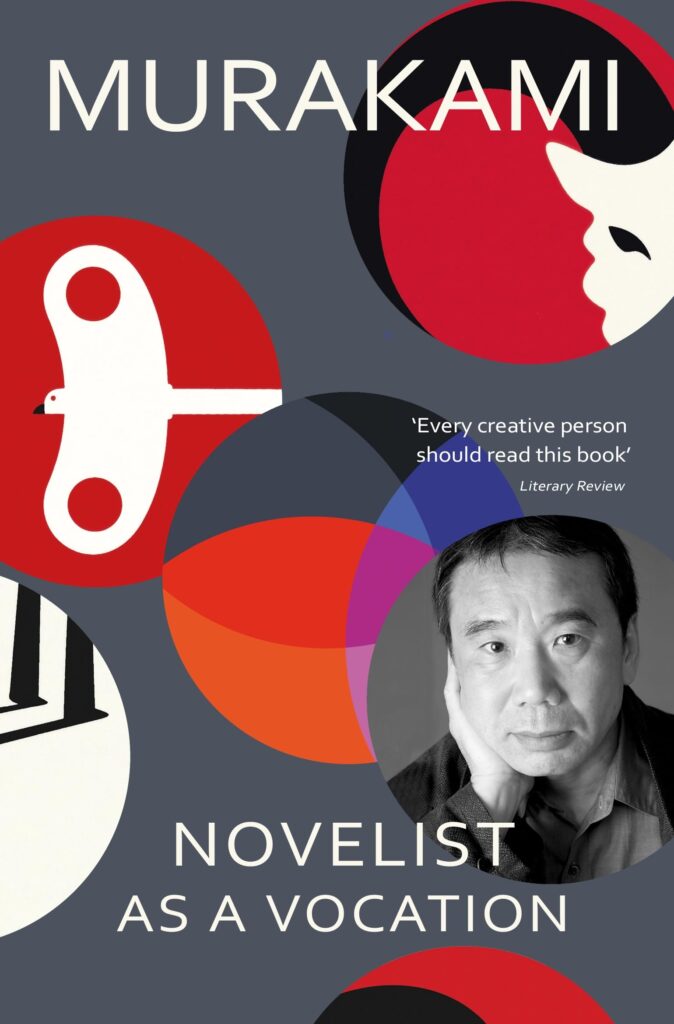
about Novelist as a Vocation
Words have power. Yet that power must be rooted in truth and justice. Words must never stand apart from those principles.
Readers who have long wondered where the mysterious novelist gets his ideas and what inspires his beautifully surreal worlds will be fascinated by this highly personal look at the craft of writing.
In this engaging book, the internationally best-selling author shares with readers what he thinks about being a novelist; his own origins as a writer; and his musings on the sparks of creativity that inspire other writers, artists, and musicians.
The book is a collection of essays on topics related being a novelist. Some of them are about the process itself like what to write about, how to write a book, and who should the characters be. The others are about tangential things like what is originality and literary prizes.
Murakami published these essays in 2015 (over a decade ago now!) so it doesn't include commentary on things that happened afterwards. Maybe they would have mattered and maybe they wouldn't have. Despite it being written a while ago and the publishing industry looking so different now due to BookTok, the core message about the essays still hold good.
The first essay is "Are Novelists Broad-minded?" which I didn't expect. It's an interesting topic, for sure, but I didn't think the author would start off with it, you know? I also don't think I have heard people discussing this at all. Does it warrant a discussion? I'm guessing that the author wrote this because he had to weigh in on something. Is this a thing that people discuss often in other parts of the world?
I probably should have taken the time to answer the question myself before diving into the essay. Murakami starts the essay with a comment that novelists usually think their way is right and any other way is wrong. I found myself not agreeing with it right off the bat without being articulate why, ruining the discussion vibe a bit. It definitely made me think as I read more of the essay. I agreed with some observations and yet I couldn't agree with his point of view. But then, do I even know enough to say otherwise because I don't know authors personally. The essay left me in odds which is, in a way, a good sign.
Writing novels is nothing less than expressing yourself, so talking about the process of writing means you inevitably have to talk about yourself.
A few of the essays were mostly about Murakami's journey and process. They're quite insightful and would be helpful for aspiring writers. He has a few strong viewpoints which I haven't heard before so that was interesting. Some parts of it didn't make sense to me and even he admits that he doesn't have a clear answer. For example, he says that he just started writing one day, as if a light shone into him from the sky. So, he never meant to write, and then suddenly he wrote every day and cranked out a book that won an award. That is not how it usually goes but I guess it's nice to see that it's a possibility too.
But writing has to be supported by other things like community, financial stability, and physical strength. I appreciated that Murakami spends the time to emphasize on the different things that had to fall in place to keep him writing and the choices he made to commit to writing fully.
Murakami's career is an interesting case study because he has been writing, successfully, for over 30 years and has captured 2 different markets separately. He had a specific journey in Japan and he eventually left it to kind of start over in America. His process and actions are different in both markets and yet his books sell well in both.
Through the essays, we understand how his career shaped up in detail and understand why he made some of the choices and how it paid off. It was interesting to hear his perspective on his career and how it makes him view other artists.
Stories can exist as metaphors for reality, and people need to internalize new stories (and new systems of metaphor) in order to cope with an unfolding new reality. By successfully connecting these two systems, the system of actual society and the metaphoric system—by, to put it another way, allowing movement between the objective world and the subjective world so they modify each other—people are able to accept an uncertain reality and maintain their sanity.
I found this point really interesting. Murakami said that he thinks his work is embraced in a new market when that audience goes through an unprecedented transformation. He mentions a couple of instances where it has happened and while they're not enough proof, his hunch is interesting to think about.
His books are not the ordinary kind. I have found his fiction books quite weird as well and I didn't love any of them. But what if I read them during the pandemic? Maybe I would have enjoyed reading an abnormal book when daily life felt abnormal. I wonder if the author has written about this hunch recently considering the amount of uncertain realities we lived through in the last decade. I wonder if his books broke into new markets.
Through all of the essays, we piece together Murakami as a person. I can't say that he bares himself completely on page but we do get to know him quite a bit. It answers a lot of questions about how he has not only maintained a writing career for multiple decades but also grown it. There are so few authors who write so many books and consistently deliver quality work that pushes readers' minds. You can tell that his unconventional personality factors into it.
For example, the fact that once he commits to something, he goes all in. He sold off his business to write even though he was still an early writer. He spends several months writing and then even more months editing and rewriting. He apparently rewrites parts of the book if it receives negative feedback, even if he doesn't agree with it. His other job as a translator really helped him see his books differently as well. It also pushed him to figure out a different style. It's plainly visible just how much effort he puts into each book and hence it's actually not surprising that he's done well.
It is my belief that a rich, spontaneous joy lies at the root of all creative expression. What is originality, after all, but the shape that results from the natural impulse to communicate to others that feeling of freedom, that unconstrained joy?
My favourite essay in the book is "On Originality". I annotated the book using sticky notes, copying over quotes I liked and writing commentary on them, and this essay had the most number of sticky notes. It was clearly visible that I loved it. I have always found the cadence of his writing appealing with the way he plays with words, sentence lengths, and tone. This essay was a masterpiece in that. I loved the cadence of it so much that I actually was reading it out loud. It is written to be spoken.
Coming from someone who actively developed an "original writing style" and is known to have original ideas, it was riveting to hear his thoughts on what originality is, how to "be original", and how the definition changes over decades. He wrote the essay so well too, I couldn't help but spend a lot of time reading it, annotating it, and pondering over it. Honestly, that one essay substance to rival a whole book.
His love for creative writing really came through in the essays and it was inspiring to read. The way he spoke about finding joy in creative expression and what originality means, it made me want to pick up a pen and start writing something. Start making something.
It was interesting to see how he viewed other original—disruptive—art and the way he's seen it become normalised and loved over the decades. Because he's been an artist for a long period of time and actively works on noticing things that others may miss, he has a lot of cool observations. He explained a lot of his thoughts through mentions of music instead of just referencing other writing. He really tries to explain his points well so that the reader gets it.
A writer's greatest responsibility is to his readers, to keep providing them with the best work that he is capable of turning out.
I didn't specifically like all of the essays, mainly because I wasn't interested in some of the topics, but all of them had value. I'm sure that there's a person who would love each essay like how I loved "On Originality". It's a variety of essays about writing and novelist. I'm guessing novelists would relate to them more than I do.
I don't have any major complaints but I was frustrated with one thing. In all the essays, Murakami often stressed that these are his points of view and experience and that it may not work for everyone. I understand stressing the point once or twice or even thrice, but it was a bit much in this book. The entire book is his opinions and half of them had some variation of that note.
I'm guessing he wrote it so much because he's seen his words taken generically often and received scathing comments about it. They would've been fine if the essays were published and read individually. But since these are published together as a book, a blanket note in the begging would have sufficed. It's a minor thing but I was a bit annoyed by it because it reduced the strength in his points.
overall
Novelist as a Vocation is a compelling collection of essays. I think most creatives would like it, whether you like Murakami's novels or not. A would like to attend a talk by him in person and these essays are the next best thing.
All creative activity is, to some extent, done partly with the intention to rectify or fix yourself. In other words, by revitalizing yourself, by adapting your soul to a form that is different from what it is now, you can resolve—or sublimate—the contradictions, rifts, and distortions that inevitably crop up in the process of being alive.
chat with me!
Do you enjoy reading essays? Do you have any favourite essays or books like Novelist as a Vocation? How do you define "originality" or original ideas/voice?

Sumedha spends her days reading books, bingeing Kdramas, drawing illustrations, and blogging while listening to Lo-Fi music. Read more ➔
This sounds interesting even though him stressing not all points would be suitable for all writers and I guess that is somewhat true for most guide nonfictions, most of those are written based on experience and trial and error. So, i guess i would be fine with that. I definitely would like to try other books by author, specifically fiction before i try this. Amazing review as always.