Although I haven't been bombarded with the book everywhere (probably because I'm off social media?), I have noticed Butter quite a bit. A friend spoke about it, it's in YouTube vlogs that aren't mainly about reading, and it's displayed fairly prominently in an Indian bookstore. The last one made me finally pick it up.
It took me a long time to read (compared to my usual reading speed) but I'm finally done with it, so let's talk about it.
about Butter
The cult Japanese bestseller about a female gourmet cook and serial killer and the journalist intent on cracking her case, inspired by a true story.
There are two things that I can simply not tolerate: feminists and margarine.
Gourmet cook Manako Kajii sits in Tokyo Detention Center convicted of the serial murders of lonely businessmen, who she is said to have seduced with her delicious home cooking. The case has captured the nation’s imagination but Kajii refuses to speak with the press, entertaining no visitors. That is, until journalist Rika Machida writes a letter asking for her recipe for beef stew and Kajii can’t resist writing back.
Rika, the only woman in her news office, works late each night, rarely cooking more than ramen. As the visits unfold between her and the steely Kajii, they are closer to a masterclass in food than journalistic research. Rika hopes this gastronomic exchange will help her soften Kajii but it seems that she might be the one changing. With each meal she eats, something is awakening in her body, might she and Kaji have more in common than she once thought?
Inspired by the real case of the convicted con woman and serial killer, "The Konkatsu Killer," Asako Yuzuki’s Butter is a vivid, unsettling exploration of misogyny, obsession, romance and the transgressive pleasures of food in Japan.
Content warnings: fatshaming, sexism, death, murder, grief, detailed food (including meat) descriptions.
my review
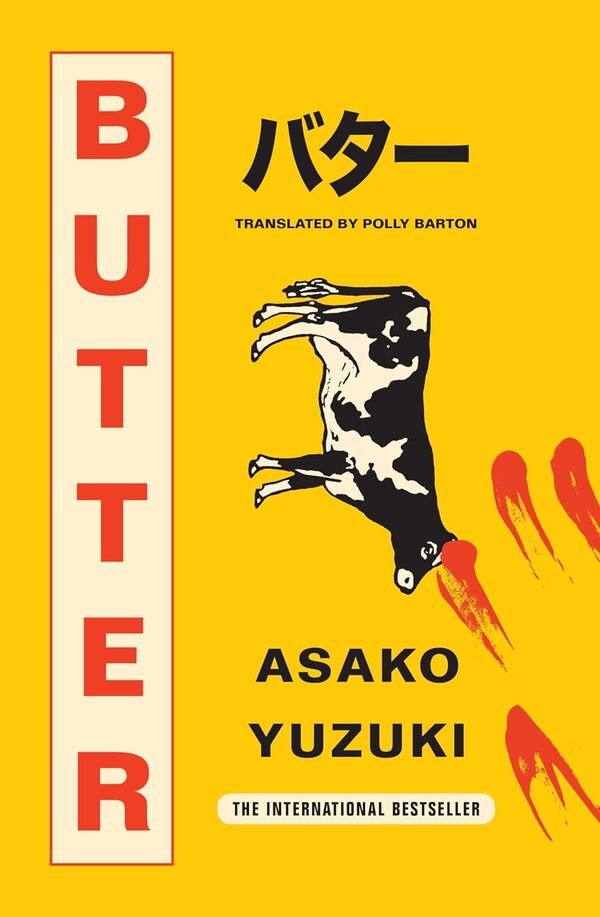
The title and cover intrigued me (although the cover is quite weird, considering it has a cow and blood on it and is for sale in a country having a majority of Hindu population who absolutely revere cows), but the description made me the most curious.
The plot is really cool. Inspired from the real story of the Konkatsu killer, Butter is about a journalist Rika Machida who is trying to get an exclusive interview from Manako Kajji who is arrested for allegedly murdering three men by seducing them with her cooking. That itself got me interested, but there's so much more to the story.
Summarizing the plot from my point of view, it's a book about flawed and twisted people who are forced to reckon with what makes them so twisted.
We know from the start that Kajji isn't an example of a good human being. Rika seems boring for a long time before we realise that there's a lot of not-right stuff inside her brain. Then there's Rika's best friend Reiko who goes from being a cookie cutter housewife to an unhinged woman on the loose.
None of it is obvious. None of it is in-your-face like in most fiction novels. The beauty of Butter is how humane and understandable it makes them even though we clearly know that they're not "okay". It's a commentary about how all of us are twisted in our own ways, mostly due to seemingly regular things in life. We're all two steps away from losing it.
In principle, all women should give themselves permission to demand good treatment, but the world made doing so profoundly difficult.
I really liked the nuance and depth in the main characters. Although there are several supporting characters, there was simply no space to go into their stories because there was so much to unpack about the main 3.
Rika, Reiko, and Kajji are very different women from different backgrounds but they're all lonely and fighting in their own ways.
The book takes us through the good and the bad of each of their lives. We see their childhood, defining moments that led them to where they are now, and every aspect about their present. We get them to know in an intimate level that feels uncomfortable at times.
Rika is a tomboy-ish girl with an aloof boyfriend and a not-so-great job. An exclusive interview with Kajji will change her career. It seems like a good enough reason but, why Kajji? Why this story out of everything else? As Rika grows closer to Kajji and sees the world through the other woman's lens, she's forced to face her demons and her life begins to change.
Kajji is a murderer. There's no doubt about this. She is the embodiment of everything that society hates in a woman, and yet she was loved by rich men and lived a lavish life, so why did they have to die? This isn't a whodunnit. Instead, her story is dug into and pieced apart to understand how she got there. It's a bit similar to Adolescence (Netflix show), in a way.
Reiko is a great cook, has a great husband, lives in a good family home, and recently quit her job to start a family. She is on track to have the perfect life. Then why is she full of cracks? Why does she break out of nowhere? It doesn't make sense. But it also clearly makes sense.
I liked how each of their issues somehow related back to their childhood. Even though they're middle-aged women who "should have" left their childhoods behind, technically they only buried them in the back of their minds and didn't realize how their choices were because of it. It felt realistic because most of are influenced by our childhoods no matter how removed we are from that time.
Don't you think that's a disease of the contemporary age? It feels like these days our value is determined by how much effort we make from day to day. That matters even more than our results. After a while, the concept of effort starts to become mixed up with things feeling difficult, and then you reach the point where the person seen as the most admirable is the one suffering the most. I think that's the reason people are so vicious towards Manako Kajii. She refuses to live that life, refuses to suffer.
At it's core, Butter is a feminist novel. It doesn't say it outright or show the characters actively fighting against stereotypes as part of "feminism", but it highlights feminist issues throughout the story.
Kajji's story went more viral than it should have—than other such murders have—because she was "fat" and hence "ugly". No one could believe that she was able to make rich men fall in love with her. This stays true to the story of the Konkatsu killer. That Kajji, a woman who should be ashamed of herself because of her body, stands tall and proud and isn't afraid to be loud was something that "went against society."
Rika, the journalist, puts on weight as she begins to enjoy food and soon it colours every relationship she has with others. People are concerned for her, comment on her weight gain, suggest she eat less, and consider it a sign that she has "let go." Having never faced such "concern" from others for her body, she begins to question it all.
The story deals with the pressure on women to look a certain way and their relationship with food. As Rika begins to enjoy food and listen to her body, she gains weight which comes with a bunch of other things. We see her trying to cut back on food and then realising that there's no reason she should.
Butter (the food item) is key because of what it signifies. Really good butter is full of fat. It elevates dishes and is a delight to eat, but it causes weight gain. So do you stop eating butter? Or do you decide to enjoy it and not care about what others say?
To make something yourself that you wanted to eat and eat it the way you wanted - was that the very essence of gratification?
Speaking of food, the book is filled with food descriptions. It's great for a while but gets annoying later on. The first dish described was steaming rice with soya sauce and butter on top—it made my mouth water. Reading all the descriptions of food will make you hungry. You might want to cook and/or eat those dishes as well.
Unfortunately, it wasn't all good for me because most of the food had meat and I'm vegetarian. I tried reading some to keep up with the main character's thoughts and feelings but I simply could not. At one point, there is painstakingly intricate detail spanning multiple pages about cooking a turkey—it made me disgusted. I cannot deal with meat.
I skipped all of the food descriptions wherever meat was mentioned. I do think it meant I lost some context of things because there is an overwhelming amount of meaning put into each food item. The author even connected the blood of cows to butter which lowkey ruined butter for me. I'm glad I skipped the rest of the descriptions.
Her loved ones' issues were their own domains, as individuals, and not places that she could go stomping into. Quite possibly, the only thing she could do was to create a place of refuge where the people close to her could come when they needed to.
I loved how the book ended. It wasn't a strictly happy ending in that everything worked out nicely, but it is a fairly realistic happy ending. I loved that it focused on having a good community and relationship with self. Instead of chasing romance or attention, it showed that having a good community of people whom you can help and receive help from in return, with whom you can enjoy good food, is what makes life good.
Despite most of the book being bleak in various ways, the book ended on a great note. I loved that we got to see all our beloved characters. I liked how the plot reached that great ending, through all the twists and turns. I finished the book with a smile on my face.
However, despite the good ending, I can't say that the book was a good reading experience because the writing was too slow and monotone. Some lines were great which made me want to annotate but most of the writing was not interesting. I had to force myself to pick up the book until I crossed the 60% mark. I didn't care about characters for most of the book, which made it hard to root for them or care about the plot overall.
The last ~200 pages were good but they don't make up for the first 250. I can't say that the last bit is worth struggling through hundreds of pages.
overall
It was a good read, but not one that I'll cherish.
I liked so much about it, as I detailed above, but I had to force myself to read a lot to get there. The book can easily put a reader into a reading slump, that's how dreary the writing is in the first half. I wanted to annotate quotes while reading but I didn't because I knew that the book wouldn't end up being good enough to keep on my shelves. I waited to see if I'd change my mind like with What You Are Looking for is in the Library but I didn't. I'm going to unhaul the book the next chance I get.
If you're truly interested in the book's content and don't mind boring writing, read the book. It is a literary fiction novel that makes you work through it before being interesting. If you're easily prone to boredom or book slumps, don't pick it up.
chat with me!
Have you read Butter? Do you like Japanese literature? I find that most of them follow the same writing style of monotone narration, which I'm not fond of. Is there any particular literature that you love because of its distinct style?

Sumedha spends her days reading books, bingeing Kdramas, drawing illustrations, and blogging while listening to Lo-Fi music. Read more ➔
Great review, Sumedha! I've picked up Butter a few years ago (French edition) before it went viral and I loved it. On my first reading I did find it too slow and meandering, but the second reading elevated the experience quite a bit.
I find that most japanese books in translation (at least those published in France: Before the Coffee Gets Cold et al.) feel pretty shallow, both in terms of their dry writing style and shallow characterization: those I come across focus on a cute gimmick (usually a place) to draw you in, but leave you a bit hollow in the end. Butter is one of the few novels that doesn't do that, and I love how it takes its time to develop its themes and characters beyond the obvious. On my second reading, I appreciated the slow pace more as it made me feel like I had really taken a journey with Rika, Reiko and Kajii and got to understand them as people (or at least, as mich as Kajii can be understood).
And the food description is great, but I understand why, as a vegetarian, it wasn't your cup of tea all the time 😅
This sounds different, raw and deep. Do you think the plot connects to that cover?
It actually does! The cover is odd and the connection isn't obvious until most of the book, but it makes sense.
Love your review! Agree that talking about blood and butter together is gross. As someone who eats butter very less to not gain weight, the book will be quite interesting, though I guess it says the same thing that we all know. But I want to get into the hype haha.
I love japanese literature although I have only read the healing fiction yet. I want to pick up other books like idol, burning and murakami. I think the monotone writing may be because of the translation? It's always difficult to figure out whether the writing is really like that in the original.
Oh no although there is discussion around Butter in relation to weight, the book is about so much more! It's about the different kinds of Butter and exactly why/how Butter elevates a dish and can give comfort and taste. Do try the book.
Wellllll, maybe? It could be due to the translation but I've see Japanese daily vlogs on YouTube from the creator which are also monotone? Translations from other languages aren't this monotone either. I feel like it's a cultural thing.
Well I will definitely read the book now!
Oh I didnt know that! Yeah it seems cultural.